Thursday, September 1, 2016
The Dangers of Misused Prescription Drugs

Using someone else’s prescription medicine is a lot like playing Russian roulette – you might get away unscathed, and then again you might not. And it could have devastating consequences. Just because we see prescription medicines advertised on TV doesn’t mean they are safe for everyone. There are good reasons why you can’t buy them over the counter. A physician takes many factors into account before prescribing a medication for you, including your current condition, your past medical history, your other medications and the likely risks and benefits of the drug to you as an individual. After making this decision he or she will then explain how to take the medication, when to take it, how much and how long to take it, what else you can and can’t take with it, and what to expect after you take it – both the good and the bad. And after all that you’ll then get an information sheet at the pharmacy giving you all these details in printed form. Taking someone else’s prescription medication deprives you of all these considerations and leaves you vulnerable to a host of problems, some of which can be life-threatening or even fatal. To learn more, in our next story, Emily reports on a deadly danger lurking in our medicine cabinets! Studies show that 1 in 4 teens admit to have taken a medicine that was prescribed for someone else. We hear from experts about seriousness of the problem.
Tuesday, August 30, 2016
Dog Behaviors and What they Mean

The pitter-patter of tiny feet is one of my favorite sounds to come home to at the end of a long day.
And I'm convinced that my dog, Izzie, is just as elated to see me as I am to see her.
But what's she really thinking when I open the front door and our eyes meet? Is she simply excited for the dinner I'm about to feed her, or do we have a real bond?
To find out more, we spoke to canine behavioral researcher Julie Hecht and Duke University professor of cognitive neuroscience Brian Hare, who wrote the book "The Genius of Dogs," and hosts a new podcast called DogSmarts.
Here are a few of the recent discoveries that Hecht, Hare, and other scientists have made about dogs:
1. Why does my dog get so excited whenever I say the word 'walk'?

Dogs, like dolphins, apes, and parrots, can learn a series of vocal commands or words. One dog, a border collie named Chaser, learned more than 1,000!
Researchers say Chaser used a process called “fast-mapping,” or inference, which is prettysimilar to how human children learn language skills. Basically, it involves guessing the meaning of a word based on the object that is being used in conjunction with that word. So if you're constantly saying "walk" and then fetching your dog's leash and taking him outside, he may be able to infer that the word "walk" has something to do with the action of going for a walk.
2. Why does my dog yawn everytime I do?

Just like people, dogs can "catch" yawns. A study in the journal Biology Letters says this "emotional contagion" is completely normal. More importantly, the researchers write, your dog catching your yawn is a sign of basic empathy.
Dogs are believed to empathize with us in other ways as well. A University of Helsinki study suggested that dogs can sense when their owners are angry and have even evolved to respond accordingly. Another study found that dogs respond in a similar way, physiologically and behaviorally, to people when they hear a human baby crying.
3. Why do dogs turn away from us when we try to hug them?
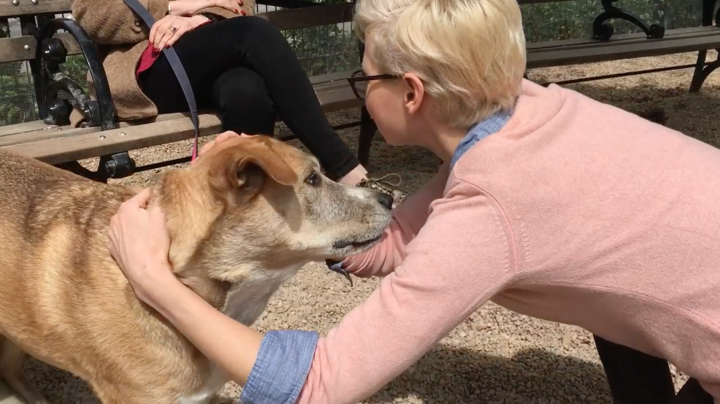
A psychologist who studies canine behavior found a disturbing trend in 250 photos of people hugging dogs — the dogs were not happy. How do we know? According to animal behavior researcher Julie Hecht, there are three common signs of stress in dogs: 1) Turning their heads away from the thing that's bothering them; 2) Showing the whites of their eyes; and 3) Lowering or pinning back their ears. Most of the dogs in these photos were showing these signs.
Still, some dogs might tolerate a hug, especially if it comes from someone familiar. In other words, dogs have myriad ways of showing affection, but hugs may not be one of them."Interactions work best when dogs set the tone and pace," Hecht told Business Insider. "Let friendly dogs initiate contact through sniffing and then show you where they want to be pet."
4. Why is my dog having a staring contest with me?

How long your dog looks at you might reveal a surprising amount about how he understands emotions.
Scientists measuring the amount of time horses spend looking at something have suggested that long looks can indicate what researchers call an "expectancy violation," or what Julie Hecht refers to as the "What what?" double-take.
But in dogs, long looks may indicate the opposite — one study found that dogs looked longer at images of dogs where their facial expressions matched the emotional tone of a sound that was played at the same time. In other words, a lingering look may indicate that your dog is processing matching emotional signals that you're giving him, such as a smile and pat on the head.
5. Why won't my dog stop smelling my friends?

Like other animals, dogs get tons of information about their environment based on what they smell. Beyond that, however, some studies suggest that dogs actually enjoy the smell of their familiar humans like their owners. One recent study, for example, found that when dogs were exposed to the scent of a familiar person, their brains may have interpreted that scent as a reward.
For the study, researchers put dogs into a brain scanner and exposed them to five different smells: themselves, a familiar human, a strange human, a familiar dog, and a strange dog.
When dogs sniffed the familiar person smell, a part of their brains linked with processing rewards showed increased activity — even more so than when they smelled the familiar dog. "This speaks to the power of the dog's sense of smell, and it provides important clues about the importance of humans in dogs’ lives," the researchers wrote in their paper.
6. Why do dogs hide behind peoples' legs?

Remind you of something a toddler might do? Behavioral research suggests that dogs are the only domesticated animals that interact with their humans in a similar manner to the way that human infants interact with their parents. Unlike cats or horses, dogs that are scared or worried will run to their owners for help and comfort, in much the same way a toddler runs to their parents, Theresa Fisher points out for Mic. By contrast, cats and horses simply run and hide.
7. Why do dogs love snow?

Remember when you were a kid and couldn't wait to jump in piles of fresh, just-fallen snow? Well, when it comes to the powdery white stuff, "dogs might be a lot like us," writes Hecht.
Gordon Burghardt, a professor of psychology at the University of Tennessee who wrote the book, "The Genesis of Animal Play: Testing the Limits," put it this way to Hecht: "Many animals from temperate areas seem to really enjoy frolicking in the snow. I think it relates to the sensory qualities of snow...when watching dogs in snow we are not too far off in comparing their activity to that which we experienced as young children ourselves."
Monday, August 29, 2016
How to Save Money on College Textbooks?

College textbook buying is an expensive routine for every student. But sympathetic professors and easy access to information tools can make it easy to find ways to cut costs. Take advantage of those tools and use them to shave some serious money off of your textbook expenses.
Over the last few days, I’ve heard from a handful of college students that are facing the start of their fall semester in college and are looking for smart strategies for trimming their expenses when it comes to textbooks. Here’s an example message from Jen:
I just priced out my books for fall semester and the total was $950 from the campus book store. Even on Amazon they are really expensive. There has to be a better way to do this.
You’re right, Jen. There is a better way to do this. Over the past few years, I’ve had a lot of younger friends and family members ask me for help in finding cheap textbooks for them and here are the strategies we’ve used that have really worked.
The usual routine that people go through when buying college textbooks is that they head to their university bookstore—or, more often these days, the online bookstore for their university—and search for each of their classes. For each, there’s likely a book or two or three listed, so you’ll just add them to the shopping cart and pay.
That’s a mistake. The first place you should look is at your class syllabus that lists the textbooks for the class.
Why look for the syllabus? The syllabus will usually indicate which books are actually required and which ones are optional. It will also usually indicate whether the most current version of the book is necessary or whether older versions are clearly acceptable.
Just by looking at the syllabus, you might cut the number of books you need to buy and, at the same time, expand the number of editions that can fulfill your needs, making it easier to find used books.
Ask the Professor if Older Editions Are Acceptable
If a professor has a syllabus that lists a specific version of a textbook, send your professor a quick email (or, if you’re in class on the first day, raise your hand). Simply ask whether previous versions of the textbook are acceptable and, if so, which versions.
In many of my classes, previous versions of a textbook were perfectly acceptable, up to a certain point. Usually, each version of a book has a few changes, but over a number of editions, those changes accumulate and significantly alter the textbook.
Most professors are fine with the students using the previous version of the book or even an earlier version than that. You just need to make sure what versions actually work for the class.
Check the University and Community Libraries
Once you’re certain that you know what books are needed for the class, start checking the university and community libraries.
For a lot of classes, this won’t be helpful, but for some classes, such as literature classes or some history classes, the library may in fact have the book that you’re looking for.
If you can find books you need from the library, the book becomes free, at least for a while. A friend of mine was able to check out a book for his English Lit course from the community library and renewed it twice, meaning that he was able to keep it for the full time that he needed it for the course.
Use “Occupy the Bookstore” to Compare Prices
So, you’ve finally realized that you do have to pay for some of your books. If that’s your situation, I highly recommend using Occupy the Bookstore, a free Google Chrome add-on that will make this whole process much, much easier.
Just add the extension to your browser at the link above, then head to the website of your university bookstore. Look up the books you need for your classes. As you visit the page for each specific book you need, the extension will pop up, giving you a long list of options for other places to buy the book—and that list is sorted by price by default.
What I usually suggest that people do is use Occupy the Bookstore, find the book they want, then browse the list for the first store that they trust (like, say, Amazon) and buy from there.
Rent, Don’t Buy, Most of Your Books
Many online sources for textbooks, such as Chegg, offer rentals rather than purchases. It’s a simple process, really—you pay a lower price than you otherwise would, they send you the book, and you have to send it back at the end of the semester. Then, they’re likely to “rent” that book again to someone else at the start of the next semester. Most of these stores usually have a “buy” option if you realize that you’ll actually need the book beyond the semester.
For most of your classes, you won’t actually need or want that book for longer than a semester, so this kind of service not only saves you something like 60% on your textbook, it also gets rid of that textbook for you at the end of the semester so you don’t have to deal with reselling it.
I actually rented a couple of textbooks using a very early textbook rental service near the end of my college career and found it to be very useful and a great money saver.
If You Must Buy, Try to Buy Used
If, for some reason, you have to buy a textbook instead of simply renting one, try to find a used version of that textbook. Most online textbook sellers—Amazon included—offer used versions of the textbook at a discounted price.
Sure, sometimes you’ll get a book with margin notes and highlights in them, but those things are pretty easily ignored, especially since you’re really just after the text and images of the book.
Buying a used version of a textbook will save you a surprising amount of money. I was largely a used textbook buyer in college and I often found that I was saving as much as 60% by buying used books. (Of course, back then, I mostly had to rely on notes tacked onto bulletin boards around campus rather than the Internet.)
If You Must Buy New, Try an eBook
Sometimes, the worst possible scenario happens. A class requires a brand new version of a textbook. Used ones aren’t available. The professor will not allow older editions of the book and has assignments requiring the new edition.
It happens. It’s frustrating. It’s going to wallop your pocketbook, no matter what you do.
The solution here is also pretty simple. If you find yourself in that kind of situation, just buy the electronic version of the textbook. The electronic versions are usually substantially cheaper than the print version of the book and it’s far easier to search through it for specific terms when you’re studying.
I’m old school—when I’m studying, I still prefer print. However, I’ve also studied using electronic sources and, honestly, if you’re in a studying mindset and know how to turn off distractions, they work fine.
Share Books with Friends
Another approach worth considering is sharing a textbook with a friend who is taking the same class as you. If you’re both taking that class, you can just buy one textbook and share it, splitting the cost.
The biggest problem with this approach is that there will probably be a key point or two during the semester where you both want to use that textbook at the same time. For example, the night before a test, you both may want to use that book.
The solution here is to study together, so if you consider following this kind of plan, make sure that the person you’re sharing the textbook purchase with is a person you can study with in a conducive fashion.
Sell Your Unnecessary Books at Semester’s End
At the end of the semester, provided you didn’t buy an ebook or rent a textbook, you’re going to be facing a decision. Do I need to keep this textbook or not? Will it help with my future classes or with my career?
If you decide to keep it, good. I found several textbooks to be useful references during my early career and was glad that I kept them around.
If you decide not to keep them, sell them during that gap between semesters. There are a lot of avenues for selling books, but it makes sense to go where the people are and sell in a high-traffic place like Amazon orCraigslist.
You won’t recoup all of your investment, but you will recoup some of it, and that money will come in just in time to buy the next semester’s books.
Final Thoughts
College textbook buying is an expensive routine for every student. Textbook manufacturers charge ridiculous prices which can really add to the financial burden of postsecondary education.
However, we live in a world of (mostly) sympathetic professors and easy access to information tools that can make it easy to locate and buy used textbooks. Take advantage of those tools and use them to shave some serious money off of your textbook expenses.
If doing so can help you reduce your student loan burden, even by a few hundred dollars per semester, that will add up to thousands over the course of college and thousands more in saved interest over the subsequent years.
Good luck!
Saturday, August 27, 2016
Career Spotlight: What I Do as an Astrophysicist

Zoom out far enough and astrophysics is really the study of everything: planets, heavenly bodies, and all that star stuff from whence we came. It’s literally a broad subject that can include anything from quantum mechanics and relativity to exoplanets and black holes.
First of all, tell us a bit about your current work and how long you’ve been at it.
To explain my current research, I have to go back to the beginning. During the Big Bang, the only elements that were created were hydrogen and helium. All of the other elements, such as carbon, oxygen, iron—all of the basic building blocks that we see in our own bodies, the planet we live on, and most of what is in the periodic table of elements—were made within stars. These elements were formed within the first stars which lived and then died in massive explosions, spreading the new elements to different regions in the universe. The new elements then mixed with the original gas from the Big Bang and coalesced to form new stars.
I started doing this research as a part of my PhD, which I got in 2012 from Arizona State University, so +6 years. Since then, I’ve been a “Postdoctoral Researcher”—which is someone who has their degree but is primarily doing research (not teaching) and learning new skills. Postdoc jobs are typically short-term, about 2-3 years, and you do maybe 1-2 of these positions in order to explore other areas of research, make connections with other researchers, and generally get your career started. I’ve been a postdoc at Caltech, San Francisco State University, and now I’m back at ASU as a member of a large research network (call NExSS).
What drove you to choose your career path?
As corny and cliched as it sounds, and because I feel that most astronomers and astrophysicists have a similar story, I was drawn to astrophysics the first time that I saw Saturn through a telescope. I was visiting some family in Miami and my uncle had a small, 3-4” telescope that we set up in the street. My cousin thought that it looked like someone had put a sticker at the end of the telescope, because you could see Saturn and its rings so clearly. But I was just stunned that you could see so much detail in something that was so far away.
How did you go about getting your job? What kind of education and experience did you need?
First, I got my bachelors degree in physics with a minor in math (from Oberlin College). Then, I went to graduate school for 6 years in order to get my PhD. As I said, I’m in the phase of my career where the jobs are relatively temporary, but I’m looking now for something more permanent, whether as a university professor, full-time researcher at an observatory, or data scientist at an institute. There are many options open to me right now.
What kinds of things do you do beyond what most people see? What do you actually spend the majority of your time doing?
I spend the vast majority of my time programming. Most people assume that astronomers spend all of their time at telescopes, but that’s only a very small fraction of the job, if at all. I do some observations, but in the past few years I’ve only been observing twice for a total of about two weeks. Once you get the data, you have to reduce it (i.e. take out the bad parts and process it for real information), usually combine it with other data in order to see the whole picture, and then write a paper about your findings. Since each observation run typically yields data from multiple stars, you don’t need to spend all of your time at the telescope to have enough work.
Also, because The Hypatia Catalog—which is really the major focus of my work—is a gigantic database, it needs to be maintained and updated on a semi-regular basis. In fact, putting together Hypatia was really what threw me into programming, since it’s not only relatively large but it’s also multidimensional. I had to figure out a good way to computationally put it together so that it could be flexible and relatively easy to update. It’s usually a big surprise to people that most of what I do involves a computer and not a telescope.
In general, people assume I study aliens. I can’t tell you the number of times I’ve been asked to “let someone in” on what’s actually going on with extraterrestrial lifeforms. More personally, people tend to associate me with Sheldon Cooper (from The Big Bang Theory), which I find rather insulting. I know they are trying to find something they can relate to, but telling someone that they are similar to a character who is entirely without social skills, empathy, patience, or a sense of humor is not particularly nice. I’d like to think that I can be a scientist and still have those qualities (or at least most of them).
What are your average work hours?
Weirdly, I don’t really have a “typical.” One of the perks of being a postdoc is that I don’t really have to be in an office by/at a particular time. In fact, a lot of times I work from home. As long as the work gets done and deadlines are met, then everyone is happy. This can be really nice if I’m exhausted and need to sleep in, for example. On the other hand, it’s a double-edged sword in that I work a lot on weekends.
What personal tips and shortcuts made your job easier?
Well first, as an undergraduate, I did a lot of research. I wanted to see what it was like and if it was something I wanted to do as career. I worked with a professor at Oberlin and then I did two summer internships through the National Science Foundation’s Research Experience for Undergraduates. All of my research projects were very different (pulsars, measuring gas ratios in nearby galaxies, and star formation) and gave me a good sense not only of the science but also the skills I would need.
The second thing that really helped me, especially as a woman in science, was when I learned to stop comparing myself (my grades, my research, my papers) to other people. When I realized that the scales for people’s success varied on a person-to-person basis, that really changed my self-confidence and allowed me to focus on being a good scientist... which, in turn, makes me a successful scientist.
What do you do differently from your coworkers or peers in the same profession? (Well, of course every researcher has a distinct focus.)
Many people in the field focus very narrowly into their chosen research topic. They know and do one thing and they do it amazingly well—they are by far the experts in their field. I take a much broader approach: I do stars but I also do planets. I do observations but I also do theoretical work (with models and simulations). I do lot of things and I find a way to tie them all together. For me, the big picture, the big patterns, are the most intriguing—so that’s what I go after.
What’s the worst part of the job and how do you deal with it?
The worst part of the job, at least right now, is the temporariness of every contract. And because jobs tend to be with universities, there are limited options within one city so getting a new job usually implies moving. I’ve moved four times in as many years, which is exhausting. It was made worse by the fact that my husband was still at ASU while I moved around, meaning we did long distance for 2.5 years. He is graduating in the next year, so another struggle we’re up against is trying to find jobs in the same city.
What’s the most enjoyable part of the job?
I get to do what I love. No doubt about it. I get to do the research that is interesting to me, with people that I enjoy, on my own time. It gives you a real sense of drive, one that I appreciate very much.
What kind of money can one expect to make at your job? Or, what’s an average starting salary?
Salaries tend to vary by city, obviously since cost-of-living changes, but in general a postdoc makes ~$50k. From there, as you become more of a “senior” scientist, you tend to make ~$70-100k, but rarely anything more than that. Being an astrophysicist typically means your life will be comfortable but not extravagant.
One of the funny little things about life in academia is that others in the field always tend to know roughly how much you make. In general, graduate students (in the sciences) make around $20k, postdocs $50k, and then it increases from there. Because of this inherent knowledge, and since literally everyone has “been there,” there is this really nice pay-it-backward mentality. Namely, senior scientists will often pay for the food/drinks of postdocs, grad students, and undergrads at social events, postdocs will pay for graduate and undergrad students, etc. It’s one of those small, common occurrences that can really make a big morale difference.
Is there a way to “move up” in your field? Do you ever see yourself working in the private sector?
As I mentioned, possibilities for me are rather open right now. So while I can see myself being a professor or a pure researcher, I can also see myself going into the private sector. I’m not sure exactly what I would do in the private sector, since working for an internet company like Facebook or Google doesn’t sound very exciting, but given my skills I believe I could find something that I’d enjoy.
What do people under/over value about what you do?
I think people tend to overvalue the extraterrestrial aspect of astronomy and as a result they tend to undervalue all of the really cool other things in space. To quote Douglas Adams, “Space is big. Really big. You just won’t believe how vastly, hugely, mind-bogglingly big it is.” And in all of that bigness are these weird, strange phenomena that we know nothing or very little about.
What advice would you give to those aspiring to join your profession?
Don’t be afraid of math. Try internships to see if/what you like about the science. Use your classmates as valuable resources; working with other students, in my opinion, is one of the best things you can do since you end up teaching each other. Find your self-confidence.
Teacher welcomes 4th-graders back to school with rap video

This is Dwayne Reed’s first year as a fourth grade teacher in Chicago — but he shouldn’t have any problem getting his class to love him.
Instead of sending out a standard introductory newsletter in advance of the start of school, Reed decided to put together a full music video. Complete with a catchy chorus, his three-minute rap song takes his students through the standards and expectations he has for the year. (No daydreaming!)
“So we gotta keep it positive, that’s the key / Have respect for each other, and don’t forget me / Have respect for your selves and the staff and the school / Having fun can be cool when you’re following the rules,” he sings.
The video has racked up over 150,000 views on YouTube and got Reed an appearance on Good Morning America this week, further solidifying his celebrity. Lucky students: this song would make anyone want to go back to school.
Wednesday, August 24, 2016
Go Behind the Scenes with Cirque du Soleil Paramour

Who were the Knights Templar?

Over the next two centuries, the Templars grew into one of the most powerful organizations in the medieval world. Their warriors, who wore over their armor distinctive white mantles emblazed with a red cross, developed a reputation for their fighting prowess, discipline and tenacity. The order’s knights swore total, unquestioning obedience to their leaders. They generally fought fiercely, in keeping with the order’s rule that a soldier convicted of cowardice would be stripped of his mantle and forced to eat on the floor for a year, like a dog. (The order also had a policy of not paying ransom for members captured in battle.) According to the 1911 edition of the Catholic Encyclopedia, some 20,000 Templar soldiers gave their lives in battle against Muslim forces over the course of the order’s existence.
In time, the Templars became a political and economic power as well. Various Popes rewarded the Templars by ordering that they be exempted from all taxation, even the customary tithing to support the Church itself. The order gradually gained numerous non-warrior members throughout Europe, who leveraged its burgeoning treasury to acquire land and buildings and to create a financial empire that functioned as one of the first European banking systems. They even gradually took control of the government in Jerusalem.

Knights Templar playing chess, 1283
After the Muslims regained control of Jerusalem for good in the mid-1200s, the Templars' fortunes began to wane. Their failure to hold the Holy Land and rumors about their secret rituals damaged the order's once-sterling reputation. In the early 1300s, the French king, Philip IV, who had borrowed heavily from the Templars, decided to avoid having to pay back his debt by destroying the order. Philip successfully pressured Pope Clement V, a Frenchman whom the Catholic Encyclopedia describes as "of weak character and easily deceived," to persecute the Templars on trumped-up charges of heresy and sacrileges, such as spitting on the Crucifix. In 1307, the French king issued secret orders for all the members of the order in his country to be arrested on the same day, and many were tortured and put to death. Clement officially disbanded the Templars in 1312. The following year, the Templars' Grand Master, James de Molay, dramatically recanted his confession as he was about to be hung in front of Notre Dame in Paris. Philip then ordered him to be taken to the Isle de la Cite, where he was burned at the stake. Remnants of the Templars, however, survived, and in the centuries that followed, chapters quietly reformed in various European countries and the U.S. and the organization morphed from a military force into a fraternal and philanthropic order. Today, the Knights Templar is on the United Nations' official list of nongovernmental organizations.

Picture: Templar initiation


